

Nagaland
Nagaland state borders the state of Arunachal Pradesh and part of Assam to the north and west, Myanmar to the east and Manipur to the south. Nagaland is largely a mountainous state. The Naga Hills rise from the Brahmaputra valley to as high as the Mount Saramati (3,840m) which merge with the Patkai Range in Myanmar. The state capital is Kohima, and the largest city is Dimapur. Nagaland can be best described as a tribal area, set in dense jungle with 16 major tribes and many sub groups that remain autonomous even though they share a cultural heritage. Among these tribes, the Angamis, Aos, Lothas and Sumis are the better known of the estimated 2 million populations. Each of these tribes speak different dialects belonging to the Sino-Tibetan family of languages. Nagamese, a variant language form of Assamese and local dialects is the most widely spoken local language. English, the official state language and the medium of education, is spoken widely in addition to Hindi. Weaving is a traditional art handed down through generations in Nagaland. Most of the tribes can be distinguished by their own unique designs, colors of costumes, jewelry and beads that they wear.
While little research has been done, the people here are renowned for their beautiful textiles and aggressive headhunting, still an active practice until about 80 years ago. About two thirds of the populations are Christians (mainly Baptist) and one tenth still practice animism.
Tourism has really to catch on, but those interested in the lives of traditional hill tribes would do well to make a visit here without delay. This vast jungle world dotted with ancient tribal villages is home of remarkably warm-hearted people with bizarre rituals and colorful festivals. Naga Villages are built on hill tops, houses were typically wood framed. Upon entrance to a Naga village, one passes an ornate tribal gate and then comes upon a central house with Methune (local buffalo) skulls over the doorway.
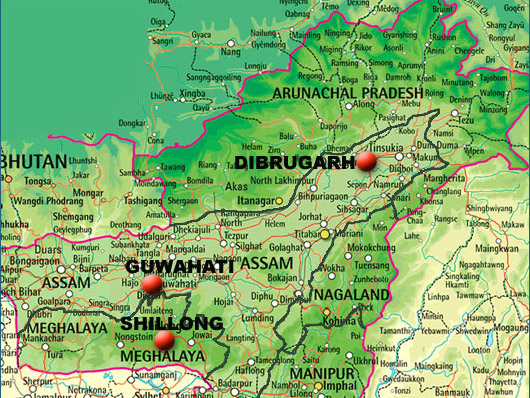
Places in and around Nagaland
Groups always run in this order. Inside each group, the must-see picks come first; hikes and places to stay follow the order Windhorse recommends.
Sights and attractions in Nagaland
11-
Sight
Chuchuyimlang
Chuchuyimlang is the village of festivals for the Ao Nagas. The Moatsu festival, based on community bonding, takes place here from May first till the third.
-
Sight
Dimapur
Dimapur, situated at an altitude of 195m above sea-level is the gateway of Nagaland. Dimapur is the main rail-head and the only airport in Nagaland.
-
Sight
Khonoma Village
Khonoma, Angkami Naga's main village is 20km west of Kohima. It is a hilltop community clinging to the slopes above the rice terraces.
-
Sight
Kohima
Kohima is a laid back, typical Asian mountain town at an altitude of 1450m. It is the capital city of Nagaland state with population of around 100,000.
-
Sight
Kohima village
Kohima village, also known as Barra Basti is said to be one of the largest and populous villages in Asia with about 4000 households.
-
Sight
Longwa
Longwa is one of biggest village in Mon district that straddles along the international boundary with Myanmar.
-
Sight
Mon
Mon town at approx.1000m in the land of Chen and Mon villages, is the main center of Mon district. Mon district is the home of the Konyaks tribes.
-
Sight
Touphema
Touphema village is 40km away from Kohima. It is an Anagami village and has huts or cottages built in traditional style to experience the Naga hospitality.
-
Sight
Ungma
Ungma is the oldest and the largest of all Ao villages, second largest village in whole Nagaland. Ungma village is located about 3 km from Mokokchung Town.
Nothing matches these filters in Nagaland yet. Choose another type or a lower star rating.
Trips that visit Nagaland
- Hornbill Festival of NagalandDay 4: Drive to Kohima - Gateway to the Hornbill Festival 7 days